
Focusing on the Fine Print: Why a Professional Dust Monitor PM 2.5 is Non-Negotiable
Introduction: The True Cost of Invisible Pollution
Airborne dust is often categorized, but when it comes to long-term health and internal air quality, one measurement stands out: PM2.5. These ultra-fine particles, measuring less than 2.5 micrometers in diameter, are the most dangerous and elusive pollutants in industrial and urban environments.
For safety managers, facility operators, and environmental compliance teams, continuous, accurate measurement of this threat is paramount. This guide explains why investing in a high-precision Dust Monitor PM 2.5 is not just good practice, but a critical investment in human health and regulatory defense.
1. PM2.5: The Health Risk That Demands Real-Time Monitoring
Unlike PM10, which can largely be filtered by the body’s upper respiratory system, PM2.5 particles are small enough to evade these defenses.
The search for sources of these particles can lead to:
Deep Lung Penetration: PM2.5 travels deep into the alveoli of the lungs.
Systemic Damage: Once in the lungs, these particles can enter the bloodstream, traveling to the heart and brain, dramatically increasing the risk of cardiovascular events, stroke, and chronic respiratory diseases like asthma and bronchitis.
Regulatory Scrutiny: International bodies like the WHO and local agencies (e.g., CPCB) are continually lowering acceptable exposure limits, placing greater pressure on industries to control fine dust emissions.
Relying on outdated or inaccurate measurement methods exposes your workforce to severe, long-term health risks. This makes a dedicated, professional-grade PM 2.5 Dust Monitor essential for defining and protecting worker breathing zones.
2. Beyond PM10: The Comprehensive Power of the Kit
While PM10 monitoring is crucial for site boundary control and coarse dust regulation, a modern solution must handle the full spectrum of threats. That is the function of the Dust Monitoring Kit PM 10 PM 2.5.
This integrated system ensures that you are covered for both particle types:
| Particle Size | Primary Source & Application | Monitoring Goal |
| PM2.5 | Combustion, welding fumes, chemical processes, indoor air. | Worker health protection and indoor air quality (IAQ) validation. |
| PM10 | Construction, demolition, vehicle traffic, bulk material handling. | Environmental compliance and site boundary management. |
By measuring both simultaneously, the kit allows managers to differentiate between local high-risk activities (PM2.5 spikes from welding) and general site emissions (PM10 from earthmoving), enabling surgical rather than blanket control measures.
3. Applications Where the Dust Monitor PM 2.5 Excels
The specialized capabilities of a Dust Monitor PM 2.5 make it indispensable in environments defined by fine particulate risk:
Indoor Air Quality (IAQ) Assessment: Monitoring offices, control rooms, and production floors where fine dust from printing, chemical use, or even HVAC failure can accumulate. High PM2.5 indoors is a direct indicator of insufficient ventilation.
Welding and Fume Monitoring: Welding operations are major sources of fine metal fumes (PM2.5). A portable Dust Monitor PM 2.5 can be used for spot-checking breathing zones to ensure LEV (Local Exhaust Ventilation) systems are correctly positioned and effective.
Cleanroom and Pharmaceutical Validation: In highly regulated environments where product purity is paramount, the monitor verifies that air filtration systems are meeting strict standards to prevent contamination.
External Events (Wildfire Smoke): With increasing environmental instability, PM2.5 is the primary pollutant during wildfire or biomass burning events. Real-time monitoring allows facilities to trigger building air recirculation or mandate respiratory protection for outdoor workers immediately.
4. Technical Specifications: Accuracy is Everything
When selecting a monitoring device, precision is critical to avoid false positives or, worse, false negatives. A professional PM 2.5 Dust Monitor is characterized by:
High-Precision Laser Sensors: These sensors use light-scattering technology to accurately count and measure fine particles in real-time, providing highly reliable data that holds up under compliance review.
Real-Time Data Transmission: The ability to instantly transmit readings via IoT or Wi-Fi ensures that data is accessible 24/7 on a dashboard, enabling instant alerts when limits (like the CPCB’s 24-hour average of $60 \text{ } \mu\text{g/m}^3$ for industrial areas) are approached.
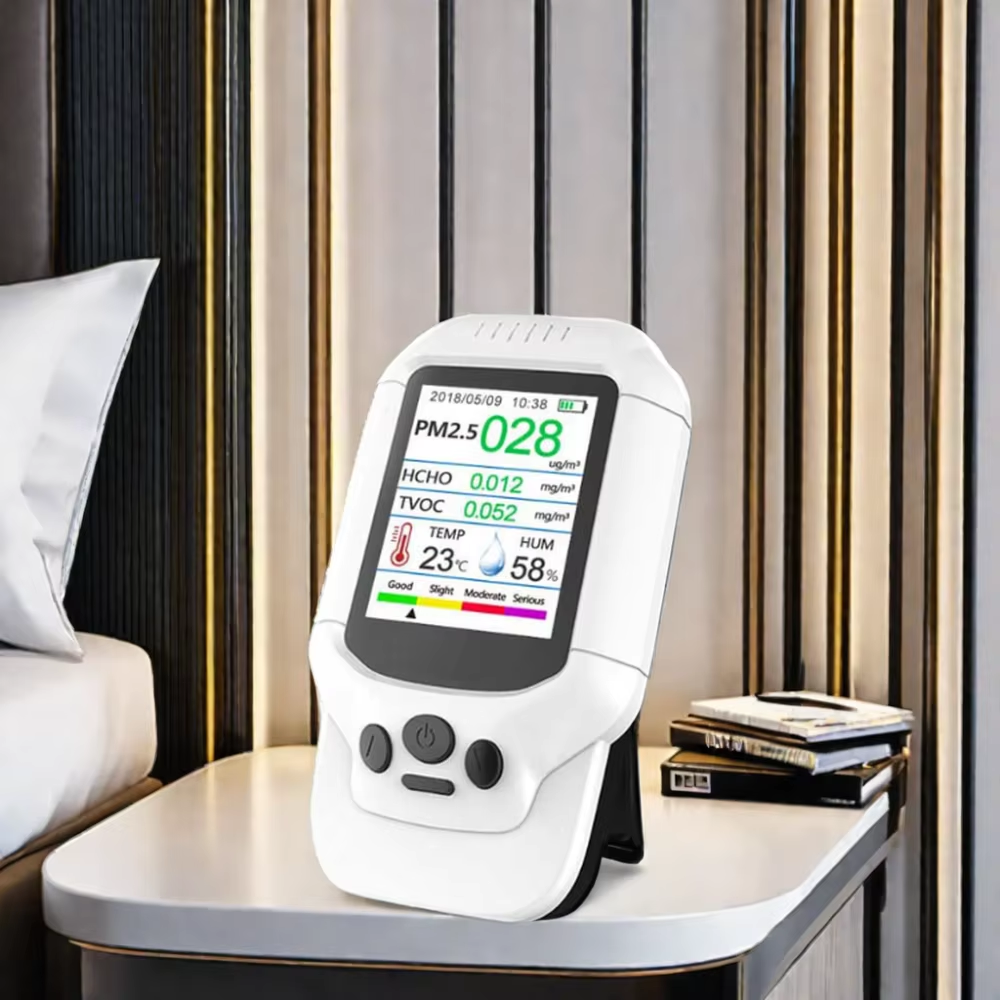
Integrated Environmental Parameters: Many professional units also measure temperature and humidity, which are crucial factors that can influence dust concentration readings and air quality comfort.
Conclusion: Proactive Protection Starts Here
Protecting your workforce and maintaining operational integrity in the face of microscopic threats requires modern, reliable technology. The Dust Monitoring Kit PM 10 PM 2.5 provides the comprehensive data you need, with the dedicated Dust Monitor PM 2.5 function serving as the essential tool for controlling the most dangerous airborne pollutants.
Don’t wait for a health incident or a regulatory crackdown. Proactive monitoring provides peace of mind and proves due diligence.
👉 Ready to upgrade your air safety standards?
Contact us to explore the full capabilities of the Dust Monitoring Kit PM 10 PM 2.5 and request a product demonstration.